


How carpooling can strengthen existing public transport networks
Public transport is the backbone of sustainable mobility. But even strong networks have limits: not every workplace, residential area or shift schedule can be served efficiently by fixed routes and timetables.
This is where organised carpooling can add another layer to the mobility system.
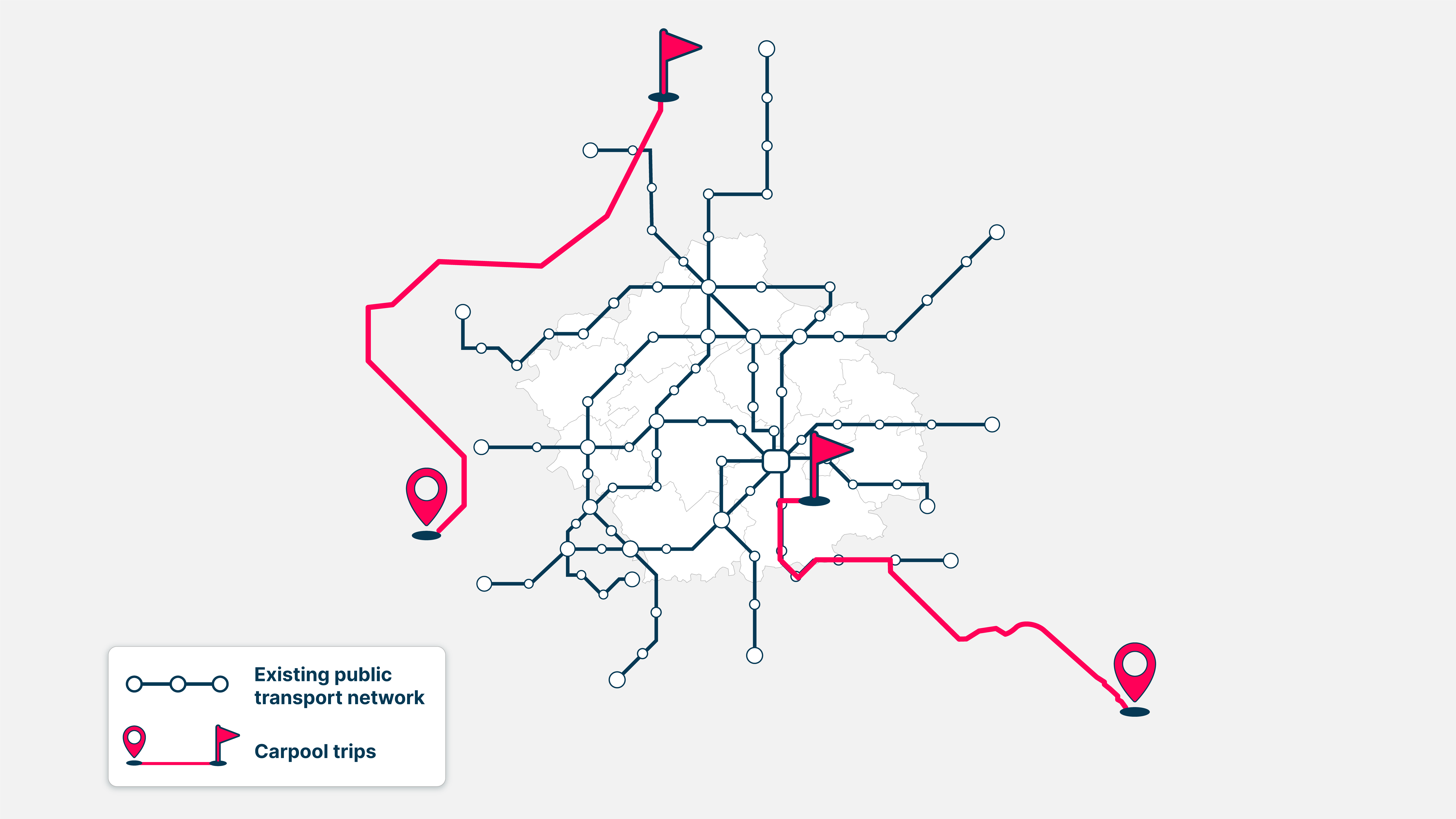
Rather than competing with buses and trains, carpooling can complement existing public transport networks by covering routes and times that are difficult or costly to serve conventionally. It uses something that already exists in large numbers: empty seats in cars that are already on the road.
Closing the gaps between strong public transport corridors
In many regions, the challenge is not the absence of public transport altogether. The problem is often the last few kilometres, an industrial area outside the main network, an early or late shift, or a commute from a rural municipality to a major employment centre.
A carpooling network can connect these missing links.
Public transport continues to serve the high-capacity corridors, while shared rides provide a flexible network around them. Because carpools are not tied to fixed stops or schedules, they can connect a much wider range of origins and destinations once enough commuters participate.
That makes carpooling particularly relevant for rural and suburban areas, business parks and large employment sites.
Integrating carpooling into existing mobility offers
The strongest models go beyond simply providing a carpooling app.
Regions and public transport operators can integrate carpooling into existing mobility systems through ticketing, incentives and local partnerships. Public transport subscriptions or job tickets, for example, can be used as an access mechanism: eligible passengers may ride for free or at a reduced price, while drivers receive compensation for sharing their journey.
This makes carpooling part of the wider public transport offer rather than a separate mobility product.
Several European regions are already taking this approach.
In Strasbourg, shared rides act as feeders to tram, bus and regional transport. In Hamburg, carpooling has been linked to an existing public transport ticket to improve access to employment areas south of the Elbe. And in Frankfurt, commuters with a valid public transport ticket can use the carpooling service free of charge as part of a wider mobility offer. More about our projects →
Different regions use different models, but the principle is the same: build on the network that already exists rather than starting from scratch.
More mobility without building new infrastructure
One of the major advantages of carpooling is speed.
New rail lines, bus routes or infrastructure projects can require significant investment and long planning periods. Carpooling networks use existing roads and vehicles and can therefore be introduced much faster.
They can help regions extend mobility coverage, improve access to employment and respond to specific gaps without having to create an entirely new transport service.
But technology alone is not enough. Successful public carpooling networks also require clear responsibilities, continuous communication, local activation, appropriate incentives and reliable monitoring.
From individual trips to a connected mobility network
The goal is not to replace public transport with private cars.
It is to make the overall system work better.
When shared rides are organised as part of a regional mobility strategy, every regular commute has the potential to become another connection within the network. Public transport provides the strong backbone; carpooling adds flexibility around it.
For regions looking to improve accessibility, reduce car dependency and make better use of existing transport capacity, this combination can become a powerful part of the mobility mix.
Meet our team